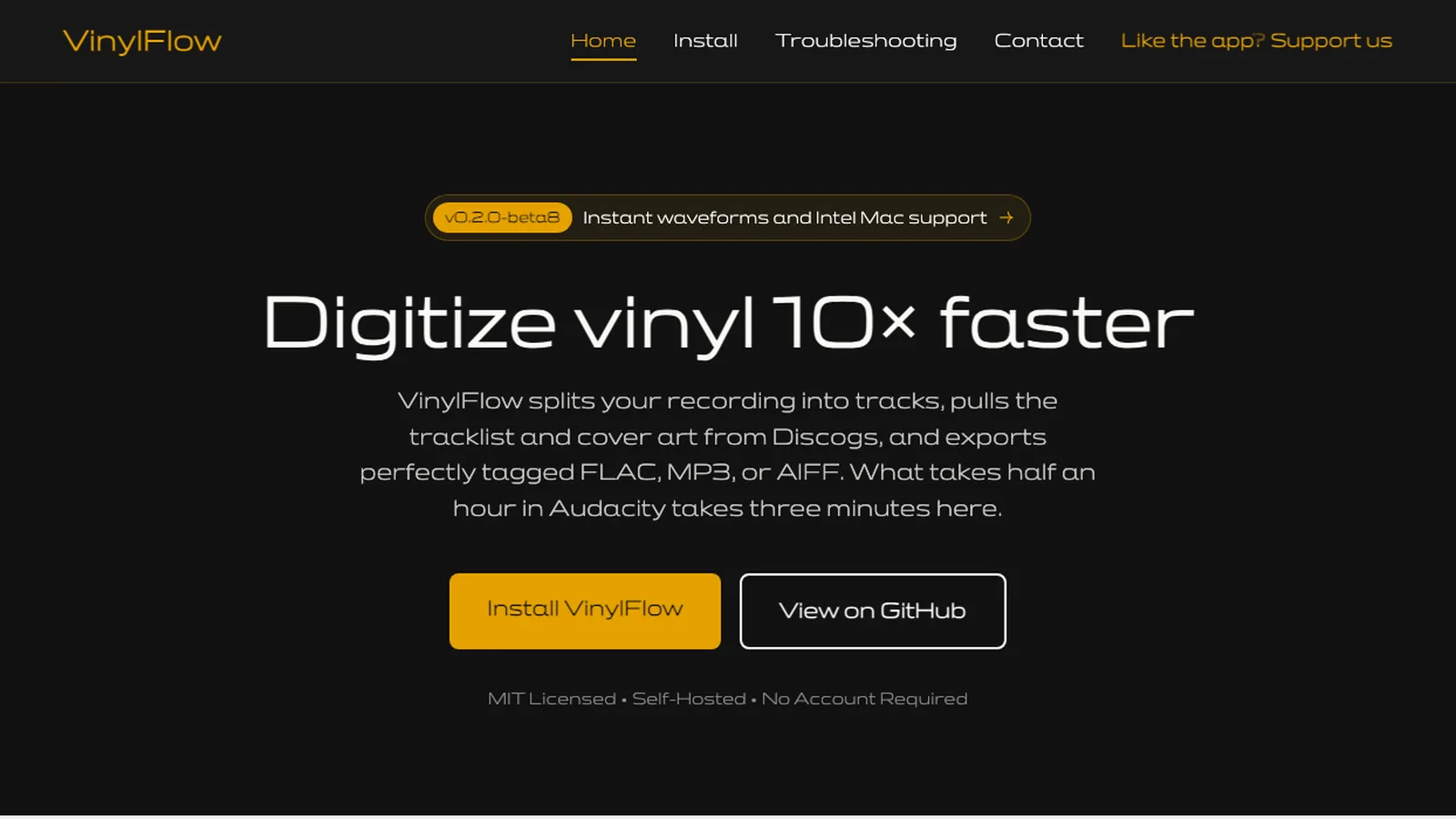
VinylFlow turns half an hour of manual audio work into about three minutes. Open source, shipped, and running on other people's machines.
Ten steps of manual work, repeated once per album, forever.
Recording a record to a digital file is easy. Everything after that is not. Record in Audacity, find the track boundaries by eye, split, export each track, look up the release, type in the metadata, find the cover art, embed it, rename everything into vinyl numbering.
That's 20–30 minutes per album. Across a few hundred records, it's a weekend project that never ends.
Automate the mechanical steps. Keep a human on the judgement calls.
The pipeline finds track boundaries by silence detection, matches the recording against Discogs for metadata and artwork, then writes tagged, correctly numbered files out the other end.
Detection is right most of the time, and mixed records have no gaps to find, so it can't always be. VinylFlow ships a duration-based fallback and a waveform editor where you drag the track boundaries yourself. Automation does the boring 90 per cent; you handle the rest.
Distribution got the same treatment. Asking people to install Python loses most of them, so it ships three ways: packaged desktop apps, a Docker image for self-hosting, and plain Python for people who want it.
Upload your recording, let it detect the tracks, pick the album from Discogs, and hit process. Done. VinylFlow README
A real product: installed, documented and supported.
Shipped, and in use by strangers.
VinylFlow launched publicly in 2026 and is live at vinylflow.app, with the source on GitHub. About 90 commits took it from first prototype to a packaged, documented, cross-platform release.
The problem it was built for is solved. A record goes from turntable to tagged files in about three minutes.