Custom CRM
Off-the-shelf CRMs are built around a sales pipeline. If your business runs on placements, bookings, jobs or members, your team ends up bending the work to fit the software. I build the CRM around the work instead, and bring your existing data with it.
Most small businesses should start with an off-the-shelf CRM. Some outgrow it in ways no setting will fix.

If an off-the-shelf CRM fits, I'll tell you and help you set it up.
A CRM that fits your work, instead of one you configure around it.
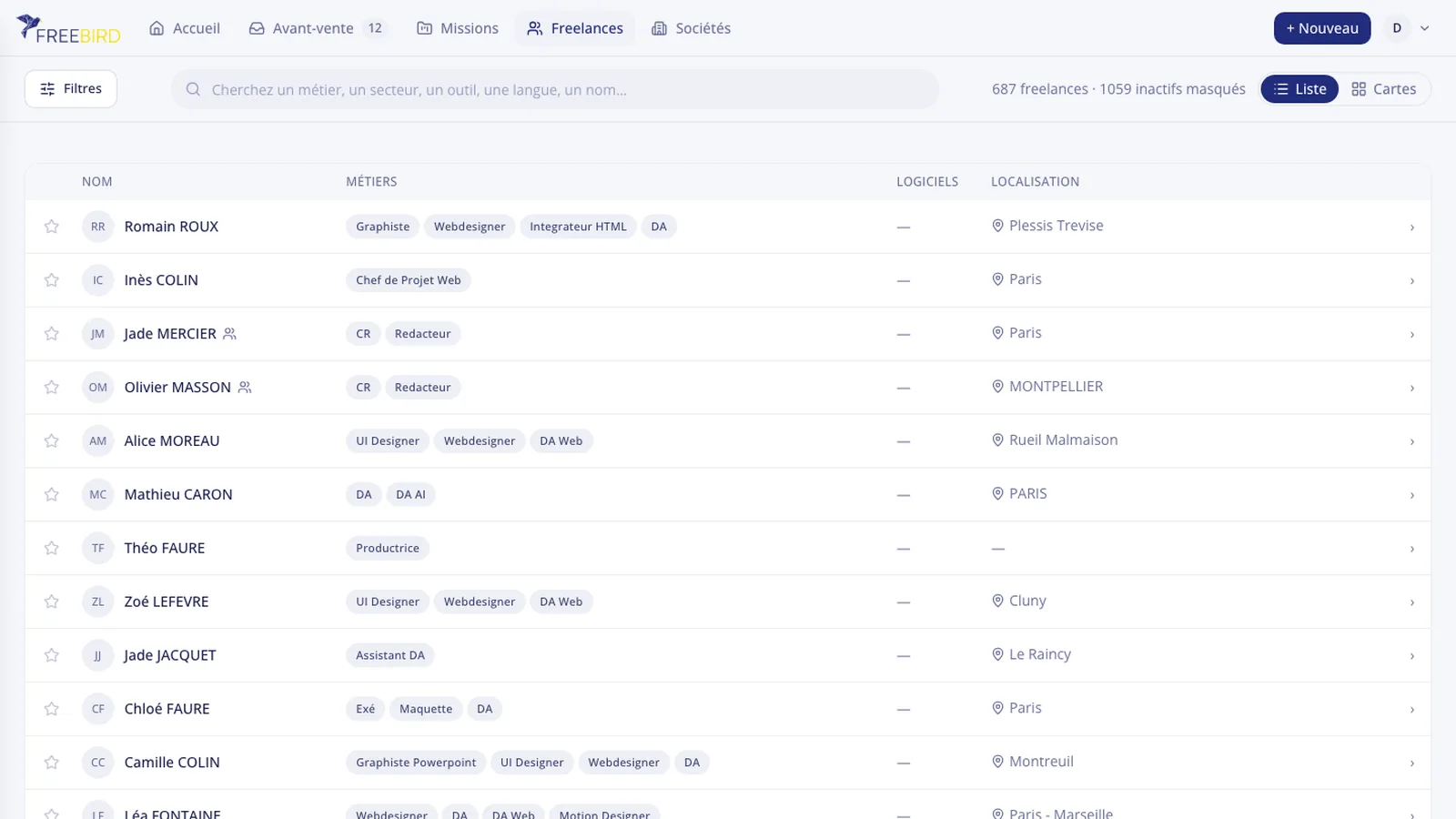
Your own record types and fields, like Freebird's freelancers, companies and missions, not a deal pipeline with renamed labels.
Filters for what your team actually searches by, such as role, skills, location or status.
Documents attached to the client, job or person they're about, not left in a shared drive.
Quotes and invoices go through to your accounting software, so nothing gets keyed twice.
Follow-ups, alerts and workflows built around your process, not someone's memory.
The whole team works in the same records at the same time, from wherever they are.
A Paris recruitment agency, built around missions instead of deals.
Freebird places creative freelancers in Paris. Its old CRM let one person at a time edit a record, and invoicing lived in a separate program on one office PC. I built a CRM around the three things the agency actually works with: freelancers, the companies that hire them, and the missions that connect the two.
Every freelancer is searchable by métier, software and location. Portfolio files sit on the records they belong to. Quotes and invoices go through to Pennylane, the agency's accounting software, without being typed again.
A custom CRM starts with an audit of how your team works today, and the price is fixed before the build begins.
Usually not at first. An off-the-shelf CRM is the right start for most small businesses. Custom makes sense once your work stops fitting a sales pipeline, or the workarounds cost more than the subscription. If the audit says off-the-shelf will do, I'll tell you.
It costs more up front than a subscription. Whether it costs more over time depends on how many seats and add-ons you'd pay for, and how many hours your team loses working around a tool that doesn't fit. The audit puts numbers on both, so you can compare before you decide.
Yes. Every record comes across with its history, and your team checks its own records in the new CRM before anything switches off. Freebird's move carried 1,781 freelancers, 886 companies and 5,726 missions.
Yes. Connecting the tools you keep is part of the build, so quotes and invoices don't get typed twice. Freebird's CRM sends them through to Pennylane, its accounting software.
It depends on how many record types, connections and years of data are involved. The audit sets the timeline along with the price, so you know both before the build starts.
We'll start with a call about how your team works today. Nothing to prepare.